




About the Alpaca
An alpaca is a very environmentally friendly animal, as it does not pull the grass it eats out by the roots, but rather cuts it, allowing the grass to regrow more quickly. It also does not have hooves, but small pads on its feet, so it does not crush the grass beneath it. It also does not require much care. The resources needed to care for the animal are therefore very low.

Withers height

total fibre yield
3 to 6 kg per animal/year
usable: 1 to 3 kg

Food

body weight
Mare: approx. 55 kg
Stallion: approx. 60 to 80 kg

Life expectancy

Peru
Home to around 80% of the world’s alpaca population.

Germany
One of the largest alpaca populations in Europe

Austria
Growing number of alpaca farms

Switzerland
Alpacas are increasingly kept for breeding and landscape management.
History & Origin
Alpacas are noble and generous animals, legendary and sensitive. In Peru, they are also a national symbol dating back to 5000 BC. The domestication of alpacas and llamas began around 3000 BC.
Alpacas have been kept and bred in the South American Andes for thousands of years. As early as the time of the Incas, their fine fibre was considered particularly valuable and was used to produce high-quality textiles.
While llamas were primarily used as pack animals, alpacas were valued mainly for their soft fibre and its use in textile production.
Alpacas are known for their particularly gentle and attentive nature. With their calm temperament, large dark eyes and soft humming sounds, they have a soothing effect on many people.
Originally from the South American Andes, alpacas are adapted to life at high altitudes. As social herd animals, they feel most comfortable in groups and feed mainly on grasses.
Compared to llamas, alpacas are smaller and generally more reserved. They are considered curious, attentive and sensitive to their surroundings. Although spitting is part of their natural behaviour, it is mainly used as a form of defence or to establish hierarchy within the herd.
While llamas were traditionally used as pack animals, alpacas are primarily valued for their fine and soft fibre. Their calm nature and graceful movements make them fascinating animals that have been closely connected to the lives and traditions of the Andean people for centuries.
Alpacas belong to the South American camelid family. They are closely related to llamas, guanacos and vicuñas, but differ significantly in their appearance, use and temperament.
Alpacas are characterised by their slender build, large expressive eyes and soft, dense fleece. Compared to llamas, they are smaller, gentler and more graceful. Their short, pointed ears and distinctive facial features give them their unmistakable appearance.
Alpacas are exceptionally well adapted to life at high altitudes in the Andes. Their dense fleece protects them from extreme temperature fluctuations and provides a fine, warm fibre that is considered one of the finest animal-based natural fibres.
- Alpacas belong to the family of South American camelids and are related to llamas, guanacos and vicuñas.
- There are two types of alpacas: Huacaya, with a dense, crimped fleece, and Suri, with long, silky fibres.
- Thanks to their soft footpads, alpacas move gently across the ground and leave fewer traces than hoofed animals.
- Alpacas are herd animals and feel most comfortable in the company of their own kind.
- With their dense fleece, alpacas are exceptionally well adapted to the significant temperature fluctuations of the Andes.
- After a gestation period of around eleven months, a female alpaca usually gives birth to a single young, known as a cria.
- Alpacas communicate with each other through body language and characteristic soft humming sounds, among other forms of communication.
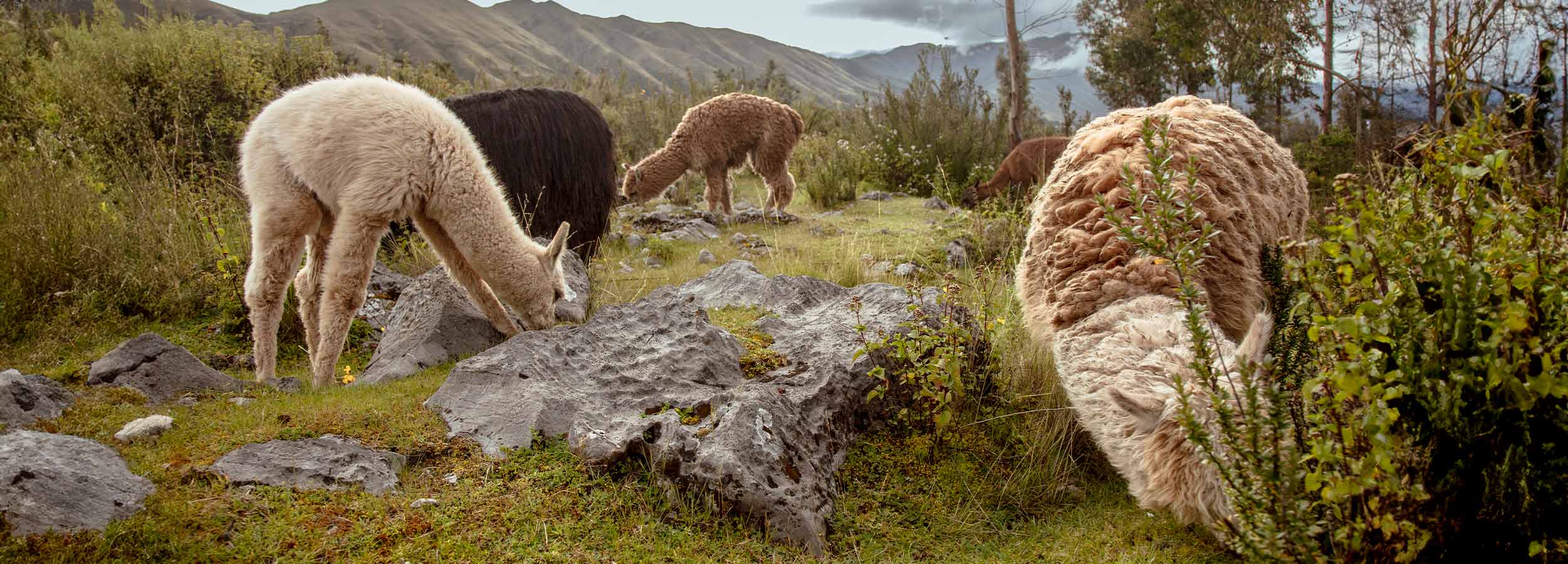
An animal with many names
The name of the animal in Quechua is allpaka, paqo, or paqocha – forms that also occur in the other living language, Aymara. Paqo is also used for a specific color of the alpaca, a dark brown color with a reddish hue, which is considered the original color of all alpacas and even other camelids.
New World Camelids
Types in Comparison
Shearing alpacas is deeply rooted in Peruvian culture, for the well-being of this peaceful and valued animal. Alpacas are generally docile animals that can be sheared easily (with some experience). They need to be sheared regularly.
While llamas shed their fleece naturally, alpacas retain theirs until it is sheared. If they are not sheared regularly, the fleece would mat, become too long, and pathogens and parasites would infest the animals, ultimately leading to their death.
The vicuña (also vikunja) is the most graceful and rarest of the four South American camelids. With a fiber fineness of 11 to 12 microns, it has the finest animal fiber in the world; cashmere, at 15 to 17 microns, is comparatively coarse. During the time of the Incas, clothing made from vicuña fibers was reserved for the nobility.
The most beautiful of the South American camels, this wonderful animal served the ancient weavers of the Andes as the most valuable raw material from which they created magnificent clothing for the Inca kings. However, in the 1960s, the Vicuña was on the brink of extinction. Thanks to a CITES rescue program, Peru alone now counts around 160,000 animals that live in the wilderness of the high Andes at an altitude of 4,000 meters.
The delicate vicuñas are carefully sheared in a respectful, traditional ceremony. Afterwards, they are released back into the wild.
The guanaco, together with the vicuña, is one of South America's wild camelids. Beneath its coarse outer coat lies an exceptionally fine and soft undercoat in natural, warm shades of brown.
Guanacos inhabit the open landscapes of South America, particularly the steppes and high-altitude regions of Patagonia and the Andes. For centuries, they have been closely connected to the culture and traditions of the Andean people. Their fiber is obtained only in very small quantities and under strict regional conservation regulations.
As a result, products made from guanaco fiber are rare and regarded as exceptionally exclusive.
The llama is the largest of the New World camelids and primarily has its natural habitat in the Andes of Peru and Bolivia.
During the era of the Incas, these animals played an extremely important role in the lives of the Andean peoples. Llamas were the most important means of transport in the Andes, and their meat was highly valued everywhere.
In the textile industry, llama wool is used less frequently than alpaca wool. The processed fibers are then used for high-quality pile fabrics, such as for coats and lightweight blankets.
The most common is the Huacaya. It makes up about 90% of the total alpaca population. Its straight, dense, crimped hair distinguishes it from the Suri alpaca with its silky and wavy fleece.
Since almost any knitted or felted product can be made from Huacaya fiber, the Huacaya is a true all-rounder and very popular among breeders.
- about 90% of the total population
- larger & wider
- feels soft, woolly, and crimped
- fiber grows straight and dense on the body
- "all-rounder" among camelids
- can be used for nearly any knitted/felted product
- very popular among breeders
The Suri breed, which has emerged from millennia of domestication by highland herders, makes up only 6% of the total population of alpacas.
The Suri is slightly smaller and slimmer than the Huacaya. The smooth fiber of Suri alpacas grows parallel to the body and hangs in long, individual locks. Its elegant style, the noble sheen of the fiber, and the graceful appearance of the Suri contrast with the softer, woolly-looking Huacaya alpacas. The Suri fiber is particularly suitable for making coats.
Baby Suri alpaca is the pinnacle of the selection of alpaca fibers, as only 0.5% of all processed alpaca fibers correspond to this noble input.